
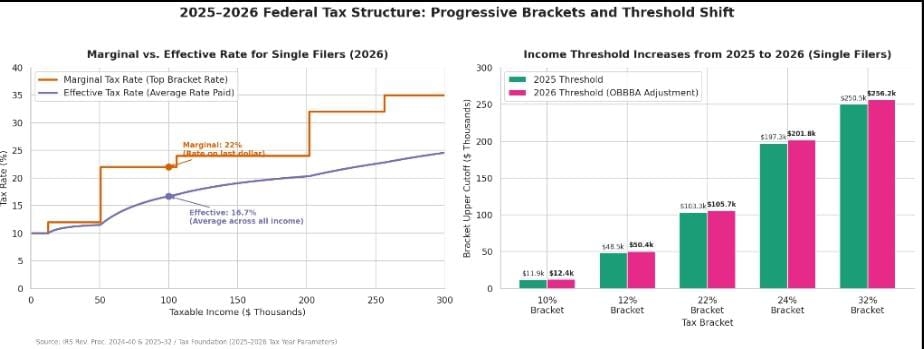
New York, United States – October 13th, 2026 – A common misunderstanding about the U.S. federal income tax system is that moving into a higher tax bracket means all of your income will be taxed at the higher rate.
In reality, the U.S. uses a progressive tax structure where different portions of your taxable income are taxed at different rates. If some of your income moves into a higher tax bracket, only that portion is taxed at the higher rate. More income will not cause your entire paycheck to be taxed at a higher percentage.
Short Answer
A higher tax bracket does not mean all of your income is taxed at the higher rate. Instead, your taxable income is divided into portions, and each portion is taxed at the rate for its bracket.
For example, if part of your taxable income falls into a 10% bracket and another part falls into a 12% bracket, those portions are taxed at their respective rates.
Key Points
-
Tax brackets apply to taxable income, not simply your total income.
-
Different portions of taxable income can be taxed at different rates.
-
Moving into a higher tax bracket does not change the tax rate on income that falls into lower brackets.
-
Your marginal tax rate is the rate applied to your highest portion of taxable income.
-
Your effective tax rate reflects your overall tax as a percentage of your taxable income.
-
Deductions and other adjustments can affect how much of your income is taxable.
What Is a Tax Bracket?
A tax bracket is a range of taxable income that is subject to a specific federal income tax rate.
The U.S. federal tax system has several tax rates. As taxable income increases, additional portions of that income can fall into higher brackets. The current federal tax rates include 10%, 12%, 22%, 24%, 32%, 35%, and 37%. The income ranges for each rate depend on filing status and the tax year.
This means you do not simply take your total taxable income and multiply it by the highest tax rate you reach.
How Do Tax Brackets Work?
Tax brackets apply different rates to different portions of your taxable income.
For example, imagine a simplified tax system with three brackets:
-
The first $10,000 is taxed at 10%.
-
The next $30,000 is taxed at 12%.
-
Any taxable income above $40,000 is taxed at 22%.
If your taxable income is $50,000, you do not pay 22% on the entire $50,000.
Instead, the first $10,000 is taxed at 10%, the next $30,000 is taxed at 12%, and only the final $10,000 is taxed at 22%. The calculation would look like this:
-
First $10,000: $10,000 × 10% = $1,000
-
Next $30,000: $30,000 × 12% = $3,600
-
Remaining $10,000: $10,000 × 22% = $2,200
The total tax in this simplified example would be $6,800.
The taxpayer’s highest tax bracket is 22%, but that does not mean the entire $50,000 is taxed at 22%.
For current federal tax rates and brackets, see the official IRS tax rate information.
Marginal Tax Rate vs. Effective Tax Rate
Two terms can help explain how tax brackets affect your tax bill: marginal tax rate and effective tax rate.
Marginal Tax Rate
Your marginal tax rate is the rate that applies to the highest portion of your taxable income.
In the $50,000 example above, the taxpayer’s marginal tax rate is 22% because the last $10,000 falls into the 22% bracket.
Effective Tax Rate
Your effective tax rate is the average rate you pay on your taxable income.
In the example, the total tax is $6,800 and taxable income is $50,000.
$6,800 ÷ $50,000 = 13.6%
So, the taxpayer’s effective tax rate is 13.6%, while the marginal tax rate is 22%.
The two rates answer different questions. Your marginal rate shows the rate on your highest portion of taxable income. Your effective rate shows the average rate across your taxable income.
What Can Affect Your Taxable Income?
Tax brackets are based on taxable income, not simply on how much money you earn.
Your taxable income can be lower than your total income after considering certain adjustments and deductions. The exact calculation depends on your tax situation.
In general:
-
Total Income: This can include wages, self-employment income, investment income, and other taxable income.
-
Adjustments: Certain adjustments can reduce the amount of income used to calculate your adjusted gross income (AGI).
-
Deductions: You may generally take either the standard deduction or itemize deductions, depending on your situation. These deductions can reduce the amount of income subject to federal income tax.
The amount that remains after applicable adjustments and deductions is generally your taxable income. That taxable income is then used to determine the federal income tax that applies to you.
Why Two People With the Same Income Can Pay Different Amounts of Tax
Two people who earn the same gross income can still have different tax bills. Several factors can affect how much federal income tax they ultimately owe.
-
Filing Status: Tax brackets and income thresholds vary by filing status. For example, in 2026, the 12% bracket ends at $50,400 for single filers and $100,800 for married couples filing jointly
-
Deductions and Adjustments: Certain deductions and adjustments can reduce the income used to calculate your tax. Depending on your situation, these may include eligible retirement contributions, HSA contributions, and certain deductions for self-employed individuals.
-
Standard vs. Itemized Deductions: Taxpayers generally take either the standard deduction or itemize eligible deductions. For 2026, the standard deduction is $16,100 for single filers and $32,200 for married couples filing jointly.
-
Tax Credits: Tax credits can directly reduce the amount of tax you owe. Unlike deductions, which reduce taxable income, credits are applied against your tax liability.
-
Types of Income: Not all income is taxed in the same way. Wages and other ordinary income generally use the ordinary federal tax brackets, while qualifying long-term capital gains and qualified dividends may be taxed at lower rates, depending on your income and circumstances.
Tax Deductions vs. Tax Credits: What Is the Difference?
Tax deductions and tax credits both can reduce your tax bill, but they work in different ways.
Refundable vs. non-refundable: A non-refundable credit can generally reduce your tax liability to zero but not below it. A refundable credit may result in a refund if the credit exceeds your remaining tax liability.
Why Your Tax Withholding Is Not Your Final Tax Bill
Many employees confuse the amount withheld from their paychecks with the amount of tax they actually owe for the year.
-
Withholding Is an Estimate: Your employer withholds federal income tax from each paycheck based on the information you provide on Form W-4. The amount withheld may not reflect your full tax situation for the year.
-
Your Situation Can Change: A new job, a change in income, additional income, deductions, or tax credits can affect your final tax liability.
-
Bonuses May Be Withheld Differently: Employers may use a separate federal withholding rate for bonuses and other supplemental wages. This withholding is not necessarily the same as your final tax rate.
-
Your Tax Return Settles the Difference: When you file your tax return, your actual tax liability is calculated based on your income and tax situation for the year. If you paid more through withholding than you owed, you may receive a refund. If you paid less, you may have a balance due.
How Tax Brackets Fit Into Year-End Tax Planning
Understanding tax bracket thresholds can help with year-end tax planning and may help reduce your overall tax liability.
-
Managing Income Near Bracket Thresholds: If you are close to moving into a higher bracket, certain pre-tax contributions may reduce your taxable income. In 2026, the 32% bracket begins above $201,775 for single filers and $403,550 for married couples filing jointly. The 2026 contribution limits are $24,500 for 401(k) plans, $7,500 for IRAs, and $4,400 for self-only or $8,750 for family HSA coverage.
-
Considering Roth Conversions: If your income is lower in a particular year, converting part of a Traditional IRA to a Roth IRA may allow you to pay tax on the converted amount at a lower rate.
-
Tax-Loss Harvesting: Selling investments at a loss can help offset capital gains. If losses exceed gains, up to $3,000 of net capital loss can generally be used against other income each year.
-
Timing Income and Deductions: Depending on your situation, the timing of income, deductible contributions, or charitable gifts can affect how much taxable income falls into a particular tax year.
Have Questions About Your Tax Bracket?
Tax brackets can be confusing, especially when your income, deductions, or other tax circumstances change. If you are unsure how the federal tax brackets apply to your situation, JTC CPAs Tucson can help you understand your tax position and answer questions about your tax return.
Key Takeaway
Tax brackets are designed so that different portions of your taxable income are taxed at different rates. Reaching a higher tax bracket does not mean your entire income is taxed at that higher rate.
Knowing the difference between marginal and effective tax rates, along with the role of taxable income and deductions, can help you better understand how your federal income tax is calculated.
FAQs
Does entering a higher tax bracket mean all my income is taxed at that rate?
No. Only the portion of taxable income that falls within the higher bracket is taxed at that rate.
Are tax brackets based on gross income or taxable income?
Federal income tax brackets are based on taxable income, not simply on gross income.
What is the difference between marginal and effective tax rates?
Your marginal tax rate applies to your highest portion of taxable income. Your effective tax rate is the average rate across your taxable income.
Can deductions affect my tax bracket?
Yes. Deductions can reduce your taxable income, which may affect how much of your income falls into each tax bracket.
About JTC CPAs
JTC CPAs provides proactive tax planning services designed to help small businesses manage tax obligations, maximize eligible deductions and credits, and improve financial efficiency. The firm develops personalized tax strategies based on each business’s financial situation, goals, and future plans. Its year-round approach helps business owners adapt to tax law changes, manage cash flow, and make informed decisions that support long-term growth and financial stability.
Media Contact
Company Name: jtccpas
Contact Person: Media Relations
Email: Send Email
Country: United States
Website: https://www.jtccpas.com
Press Release Distributed by ABNewswire.com
To view the original version on ABNewswire visit: JTC CPAs Explains How Tax Brackets Determine Rates Applied to Income
Media gallery



