
HANGZHOU, CN / ACCESS Newswire / November 16, 2026 / For the past few days, Longwu Tea Town, a small town southwest of Hangzhou that takes its name from tea, has been receiving guests. Among them are researchers from China’s top tea institutes, tea industry practitioners with decades of experience, university students and international students, entrepreneurs from across the industry chain, local tea farmers, artists and musicians. What brought them together is the Tea Olympics, an event widely regarded as one of China’s premier tea competitions. This year, it has taken on a broader meaning: from Nov 7 to 10, the 11th China Tea Olympics and the first Golden Autumn Tea Fair of Xihu Longwu Tea Town was held. The talk ranged well beyond professional matters. Another question kept coming up: how many forms can a single cup of Chinese tea take? And how many businesses can a tea-growing town spin out of a single leaf?
Technology offers one answer. Two high-level conferences on the new tea beverage sector were held during the fair. They drew leading experts, among them several academicians of the Chinese Academy of Engineering, to discuss the design of new-style tea and its supply chains. Artificial intelligence was another talking point: a technology developed at Zhejiang University has raised the accuracy of identifying tea pests and diseases to 90 percent. How a plant with a thousand years behind it enters its next era is the question the room was trying to answer.
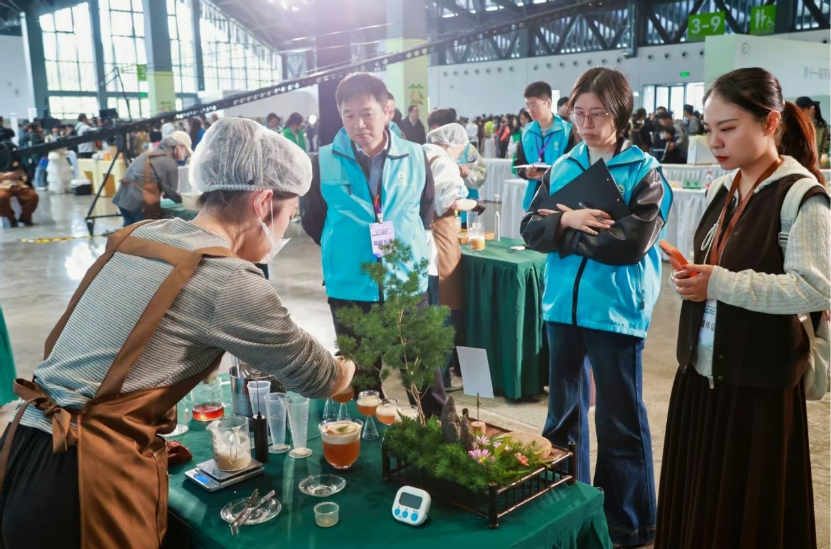
Young people offer another answer. At the new-style tea beverage competition, tea science students blended Zhejiang leaves with milk, fruit and coffee. At the tea pastry and culinary contest, chefs incorporated tea into pastries and dishes. Many of the winning entries have entered the sourcing lists of Chinese new tea beverage companies, and may soon turn up in tea shops in North America.
Culture stretches the range wider. An exhibition titled Tea Embraces All Things spread across six rooms, devoted to vessels, appreciation, food, textiles, wellbeing and creativity. A fashion show, AI devices and a series of inventive products made the same point: tea can turn up anywhere in contemporary life.
Across the outdoor program, people gathered, played and purchased creative products in the name of tea, following tea-themed routes around the town. Its villages offer visitors from different countries more than tea: boutique guesthouses, a Michelin-recommended restaurant, artist studios and workshops where visitors learn to pan-fire tea leaves by hand. What tourists see is no longer just tea fields.
In Longwu Tea Town itself, the development of Chinese tea shows many faces. The town-once known as the “Land of Ten Thousand Dan of Tea,” a dan being a traditional unit of weight-is a major producing area for West Lake Longjing and calls itself China’s No. 1 tea town. Tea-derived products here generate more than 10 billion yuan in annual output value, and the town received more than 7.45 million visitors last year. Its 11 tea-growing villages have each developed a character of their own.
The town’s influence has travelled further. Last month, at an international tea culture exchange held at the headquarters ofFAO in Rome, West Lake Longjing Tea and Jiuqu Hongmei Teafrom Longwu Tea Town were presented to guests, with tea-themed cultural products on display. More than 700 visitors from dozens of countries paused to taste Chinese tea.
How much can one leaf hold? Longwu Tea Town gives its answer: a thousand years of craft, today’s algorithms, local tea farmers diversifying how they work and live, and customers in overseas shops waiting for the next Chinese tea innovation to hit the shelves.
Media Contact:
Company: TIDE NEWS, ZHEJIANG DAILY PRESS GROUP
Contact: HU YIDI
Email: 4863283@QQ.COM
Website: https://tidenews.com.cn/
SOURCE: TIDE NEWS, ZHEJIANG DAILY PRESS GROUP
View the original press release on ACCESS Newswire


